Vlerick Students helping to shape the future of Commercial First Aid in Sub-Saharan Africa
Since 2015, Rode Kruis-Vlaanderen (Red Cross Flanders) has collaborated with Vlerick Business School to support its international capacity building programmes in Sub-Saharan Africa. Every year, a small group of Vlerick students is dispatched to one of the partner countries of Rode Kruis-Vlaanderen to work on a wide variety of different projects.
Despite the ongoing CoVID-19 crisis, this year was no exception. While the Vlerick team worked remotely, they were tasked with developing an evidence-based and contextualised Business Game to train the employees of various Commercial First Aid (CoFA) departments associated with the various African Red Cross Societies with whom Rode Kruis-Vlaanderen has a partnership. Our students happily explain how their In-Company Project came to life and how they brought it to a successful end…
The Beginning of our Journey
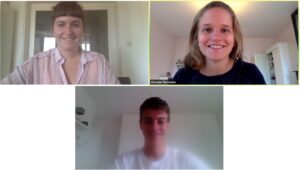 Before we start describing the challenge we had to tackle for Rode Kruis-Vlaanderen and the solution we came up with, we would like to briefly introduce ourselves. We are Victoire, Olivier and Leen. A team of three students finalising our Masters in International Management & Strategy at Vlerick Business School. Together, we were fortunate enough to be selected by Rode Kruis-Vlaanderen to work on their challenge for the duration of our In-Company project.
Our story begins several months ago on the Vlerick campus with a presentation from Arjan Keijser, not only a Vlerick alumnus himself, but also our future Red Cross supervisor. During this short presentation, all students from our programme were introduced to the amazing work done by Rode Kruis-Vlaanderen abroad and the philosophy of evidence-based practice that underpins all of it.
After a highly selective recruitment process, we were able to kick off our project mid-April. Under the guidance of Arjan Keijser, Project Manager First Aid Blended Learning, our task was to develop an interactive Business Game that Rode Kruis-Vlaanderen can use to teach the employees of local CoFA departments the basics of running successful commercial organizations.
The importance of Commercial First Aid
You might wonder why Rode Kruis-Vlaanderen is offering support for the development of commercial operations to its Red Cross partners in Sub-Saharan Africa. It is a valid question to raise, as the various Red Cross Societies are primarily humanitarian actors tasked with providing essential services to the populations they serve.
This mission however, does not preclude the Red Cross from engaging in commercial activities. Indeed, in Flanders the Red Cross is a well-known provider of Commercial First Aid trainings to companies. Commercial activities like this allow the various Red Cross Societies around the world to leverage their expertise and achieve a degree of financial sustainability that would otherwise elude them.
Rode Kruis-Vlaanderen therefore supports other National Societies in setting up such revenue-generating activities. By supporting our African partners like this, they are able to create a sustainable form of financing which strengthens their resilience and makes them less dependent on government subsidies, donations, and Western funding to finance their much needed humanitarian work.
The Commercial First Aid Business Game
Running such a CoFA department is not an easy task however and requires the right mixture of soft and hard skills. No one is born with these skills, they have to be acquired through hard work. That is exactly where our project comes: develop a Business Game with a focus on Commercial First Aid.
For the Commercial First Aid Business Game to succeed, Rode Kruis-Vlaanderen also defined seven specific requirements for us to take into account during the development process:
- Relevant to our target audience and goal.
- Based on the latest scientific insights in the fields of education, communication sciences and economics.
- Highly interactive, hands-on and varied.
- Gender-neutral and appropriately contextualised to the Sub-Sahara African countries in which Rode Kruis-Vlaanderen is active.
- Inexpensive and low-tech, so that it could even be played without internet and/or regular access to electricity.
- Highly modular and scalable, as it must be possible for the facilitators to adapt the game to the specific needs of participants, environment and timeframe.
- Able to allow for clear measurement of the progress and working points of participants.
These seven principles had to be translated into (at the very least) a clear manual for instructors, a booklet with key take-aways for participants and slide decks and other supporting materials to use while teaching the various modules. With these objectives firmly established, we hit the ground running. We started by conducting research into the organisational context in which the game would take place. Up next was a deep dive into the academic literature around gamification, business games, social enterprises, and education in Africa, to meet the BRC-FL’s high standards for using only evidence-based tools. To supplement this literature review, we conducted interviews with experts in the aforementioned topics, and with representatives of National Societies from Eswatini, Lesotho, Malawi, Mozambique, Zambia and Zimbabwe.
With these objectives firmly established, we hit the ground running. We started by conducting research into the organisational context in which the game would take place.
From these interviews, it soon became clear that we needed to create modules on Human Resources, Strategy, Marketing, Accounting, Sales, and Negotiation. After identifying key learning objectives for each module, we transformed these learnings into a variety of game formats ranging from simulations to role-plays and case studies. The next step was writing the overall storyline of the Business Game, which formed the connective tissue between the various modules. This storyline had to be as realistic as possible to maximise the participants’ engagement and motivation. We eventually came up with a simulation in which the participants build a new CoFA department from scratch and have to grow their business. By the end of the week, the participants would be able to see which team ran their newly developed CoFA department in the best way.
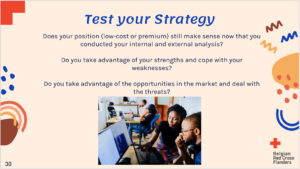
Once the modules were ready, we validated these through extensive user-testing. Playing the various modules with representatives of the African National Societies we had interviewed allowed us to tailor the content and style of the CoFA Business Game even more to the needs of their end-users. To enable future incremental improvements to our Business Game, we also developed a system of surveys to measure the learning outcomes and identify areas of improvement.
The End of our Journey
For the past two months, we have been hard at work developing our materials. In the end, we delivered over 265 pages of instructor guidelines and participant booklets, a methodological report of 88 pages, nine different slide decks (247 slides in total), four surveys and twelve types of extra tools and templates that the participants can take home with them to implement and optimize their business procedures. Collaborating with Rode Kruis-Vlaanderen has been an insightful experience for us and the ideal steppingstone to finalise our education in International Management & Strategy.
We were particularly impressed by the commitment of Rode Kruis-Vlaanderen to leverage their expertise to aid the Sub-Saharan African National Societies and we also greatly appreciated the dedication shown by the Red Cross staff to the success and wellbeing of our team. Next to this, we highly appreciated working on a concrete project that will go on to have tangible impact for many years to come. It was immensely satisfying to see how our work was received with a lot of enthusiasm by the representatives of the various African National Societies we interviewed.
 This is the story of Namit Arora, a Masters in Marketing and Digital Transformation student at Vlerick Business School, in Belgium, who is studying and completing an in-company project from home.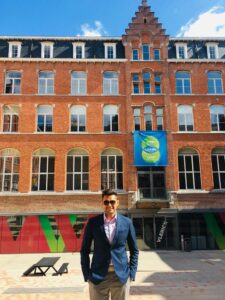
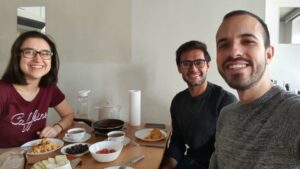
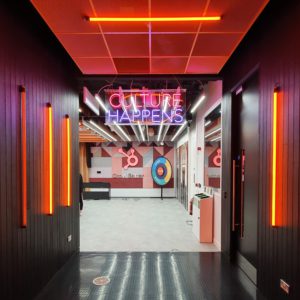
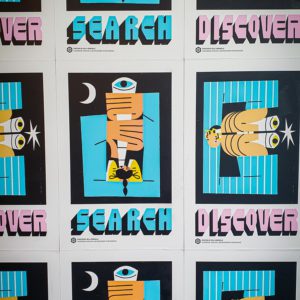

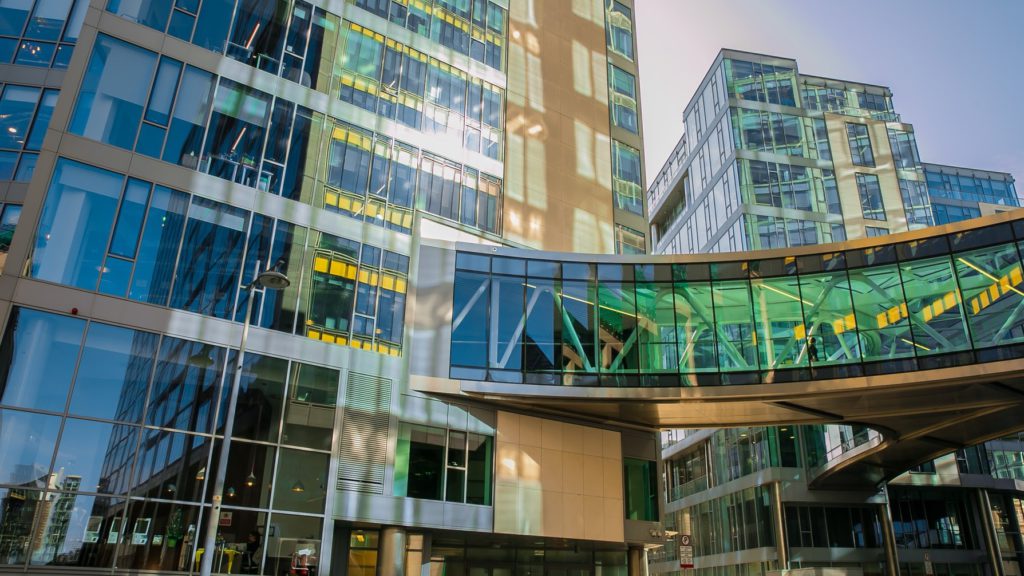
 On the last day of our Dublin trip we had the chance to visit Microsoft at their Dublin campus located in Leopardstown, half an hour south of Dublin. This €134m state of the art building inaugurated in 2018 offers over 34,000 square metres and is the home to over 2,000 employees. The Dublin division has more than 100 different nationalities which is representative of Microsoft’s pledge for diversity. All sectors can be found within the campus; engineers, operations or digital sales and human resources making this location central to the company’s European activities.
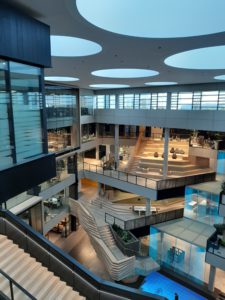 We were welcome to the company and introduced to Microsoft’s mission established by their CEO Satya Nadella in 2014; empowering every individual and organisation on the planet to achieve more. This mission is not limited to their clients; the DreamSpace is a space on the campus where Microsoft welcomes schools and allows them to interact with various new technologies. This endeavour is an example of Microsoft empowering and interesting the younger generations in technology. We were then toured around the lavish building, a marvel combining design and technology. The notable “digital waterfall” at the centre of the building, is an example of this. Spanning over four floors, it integrates seamlessly in its environment and provides a pleasant sight from all offices and restaurants.
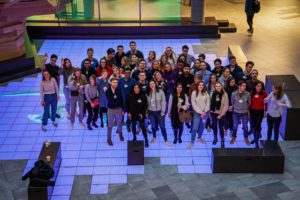 Following the office tour, we were introduced to an energizing business case that revolved around the use of Microsoft technology to digitally transform coffee chains. 5 teams scribbled down their ideas by taking inspiration from the knowledge gained in last 6 months. For instance, One of the teams reflected back on the teachings of Mr. Frank Goedertier during the Managing Customer Experience & Technology Trends course and pitched the idea of using the services of Microsoft Teams and Azure to let customer choose his favourite Barista and even give him the possibility to create his own mixture using cloud service of Azure. Two relevant Microsoft employees gave constructive feedback on the ideas and were impressed by the quality and diversity of the ideas that were pitched in just one minute.
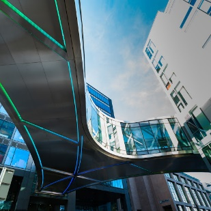 Since Google opened its European Headquarters in Dublin in 2003, the number of employees has grown from five to over eight-thousand. It now hosts 70 nationalities and 75 languages spoken, serving over 100 markets. Nevertheless, one of the first things you notice when entering a building is the familiarity between the employees. Team-spirit, accompanied by kind smiles, mark the relationship between on their work floor. Do growing companies need to construct physical bridges between offices, or is there more to Google’s close-knit communities within their mass-employment?
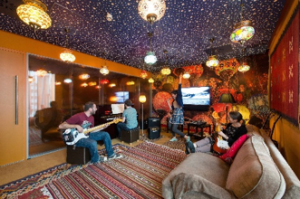 Blend formal and informal learning
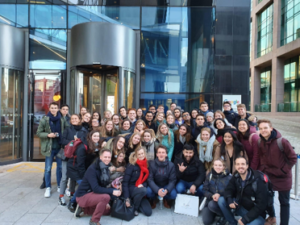 We can certainly say that Google is a company that allows its people to live, learn and leap, providing them with all the tools, opportunities and freedom to perform at work and enjoy the satisfaction of a job well done at the end of the day, with small gatherings and events across the week.
  Did you know that 80% of Instagram users follow a brand? Neither did we, until we learned all about the importance of Facebook and Instagram for businesses around the world. Especially for medium sized companies, Facebook can really boost the growth of their business. With this in mind, it is no surprise that their mission statement is to: “Give people the power to build community and bring the world closer together.”
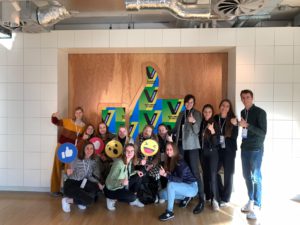 Always keep in mind the creative considerations in making the best out of your Instagram campaign.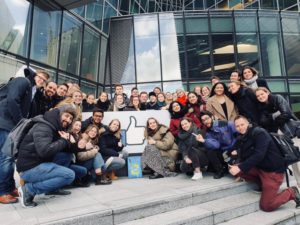
 On the second day of the trip to Dublin, our Marketing and Digital Transformation students visited HubSpot; the fast-growing scale-up. The day started by having a tour around the office. This was followed by a presentation about what the company does and how it operates. There was then a demonstration of the platform. But it didn’t stop there! The company representatives guided the students on possible career opportunities and left room for further questions through an informative round table.
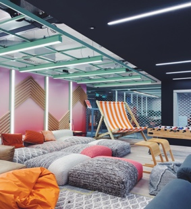 We started our visit at HubSpot with a guided office tour! It became immediately clear that they were cozy, a lot of light and dynamic. As it was lunch time not a lot of employees were at their desk, but we could see some nicely decorated ones: action figures at IT, the tiki Hawaiians bar at sales or just desks decorated with inspiring quotes to keep you going throughout the day. We came across the library that directly had a feeling of being at home, break-outs room where you could work more in silence or they even have a nap room! It is true what they say: company culture is everything and we directly felt we would fit in! They also reimburse your tuition, have a free book program and employee resource groups.
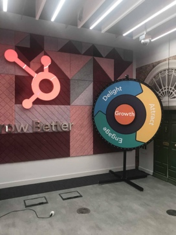 Since HubSpot is rapidly growing and seizing every opportunity they get, the company is continuously hiring. The tech scale-up has great internships and full-time graduate positions in different fields. For Marketing & Digital Transformation students they offer graduate roles in Sales, Customer Support and Product & Engineering. We had the opportunity to talk with employees in different roles and with different experience levels. They were very open in sharing their journey, success stories and challenges they face on a daily basis. The HubSpot employees also gave us a clear view on relocating to Dublin and life in Ireland. Lastly, we went over the different stages of the application process and how to optimize our chances.